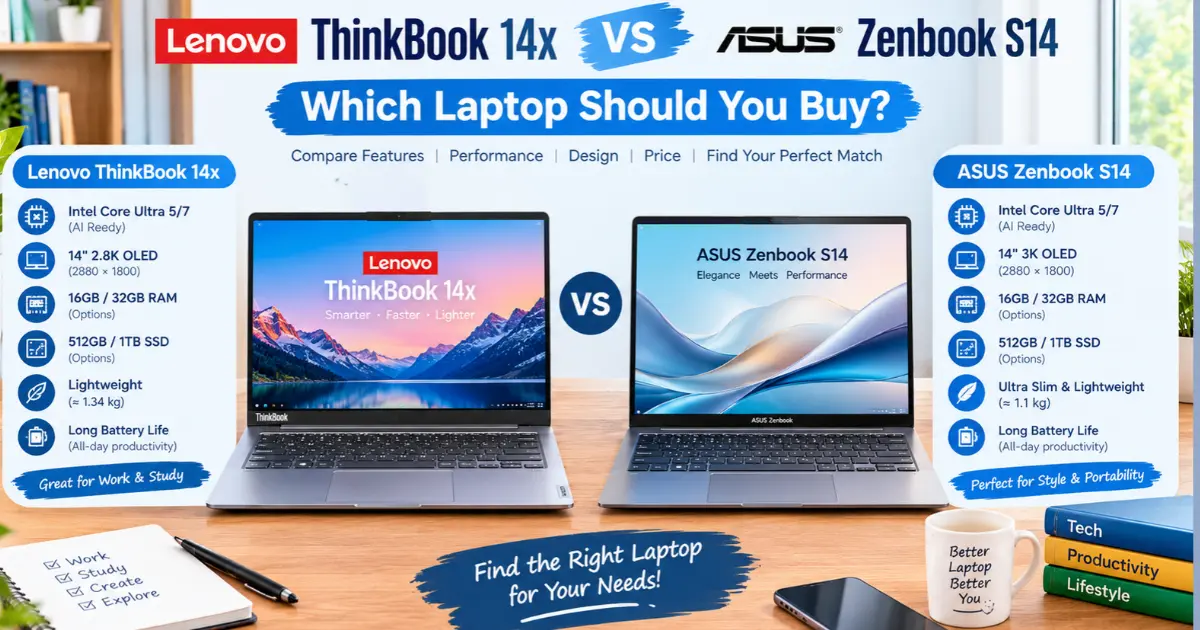
Choosing a premium laptop today is no longer just about picking the fastest processor or securing the largest storage drive. For university students, corporate executives, frequent business travelers, and remote professionals, real-world usability matters just as much. Portability, display clarity, sustained battery efficiency, thermal performance, and versatile port connectivity now dictate the daily user experience.
The Lenovo ThinkBook 14x and the ASUS Zenbook S14 are two of the most compelling 14-inch ultrabooks built around these modern expectations. Both feature ultrathin chassis, modern Intel processors with dedicated neural processing units (NPUs), integrated Intel Arc graphics, and built-in AI acceleration designed for modern Copilot+ workflows.
However, they approach the premium ultra-portable market from distinct philosophies:
-
The Lenovo ThinkBook 14x focuses on business-grade productivity, extreme featherweight mobility (weighing just ~990 grams), and an aggressive starting price.
-
The ASUS Zenbook S14 takes a luxury lifestyle approach, pairing a high-resolution 3K OLED panel with premium Ceraluminum chassis materials, expanded battery capacity, and next-generation processor options.
With a price gap of roughly Rs 31,000 between their entry models in India, which machine truly earns your investment? Should you save money with the ultra-light ThinkBook 14x, or pay extra for the Zenbook S14’s stunning OLED display and advanced hardware options?
Let’s break down every practical difference to help you decide.
Price in India and Variant Availability
Pricing forms the first major divider between these two notebooks.
-
Lenovo ThinkBook 14x: Starts at approximately Rs 1,09,990 (or Rs 1,08,990 depending on active promotional discounts) on Lenovo India’s official store. The entry-level specification includes an Intel Core Ultra 5 226V processor, 16GB of LPDDR5X RAM, and a 512GB PCIe Gen 4 SSD.
-
ASUS Zenbook S14: Starts at approximately Rs 1,40,990 on ASUS India's online shop and authorized retail partners, featuring higher-tier Core Ultra Series options, premium OLED panels, and larger battery configurations.
This sets up a baseline price difference of around Rs 31,000.
+------------------------------------+----------------------------+----------------------------+
| Feature / Spec                     | Lenovo ThinkBook 14x       | ASUS Zenbook S14           |
+------------------------------------+----------------------------+----------------------------+
| Starting Price (India)             | ~Rs 1,09,990               | ~Rs 1,40,990               |
| Starting Weight                    | ~990 grams                 | ~1.20 kg                   |
| Chassis Thickness                  | 12.9 mm                    | 11.9 mm to 12.9 mm         |
| Primary Display Options            | 14" WUXGA IPS / 2.8K OLED  | 14" 3K OLED (2880 x 1800)  |
| Refresh Rate                       | 120Hz                      | 120Hz                      |
| Base Processor                     | Intel Core Ultra 5 226V    | Intel Core Ultra 7 / 9     |
| Battery Capacity                   | ~54.7Wh to 65Wh            | 77Wh                       |
| Memory (RAM)                       | 16GB LPDDR5X (Soldered)    | 16GB / 32GB LPDDR5X        |
| Military-Grade Testing             | MIL-STD-810H               | MIL-STD-810H               |
+------------------------------------+----------------------------+----------------------------+
Buyer’s Tip: Always verify exact hardware components before buying. Lenovo’s custom-to-order system lets you upgrade display and storage independently, whereas ASUS bundles higher processors directly with premium OLED display specifications.
Design, Build Quality, and Real-World Portability
If you carry your computer around all day, physical design and chassis weight become top-tier purchasing criteria.
Lenovo ThinkBook 14x: The Sub-1kg Champion
The ThinkBook 14x achieves a remarkable engineering milestone by staying under the 1-kilogram threshold—tipping the scales at approximately 990 grams with a sleek 12.9mm profile.
-
Who it helps: Commuters using public transit, university students walking across large campuses, and executives who live out of carry-on luggage.
-
Aesthetics: Crafted from anodized aluminum, it sports a clean dual-tone metallic gray finish. It looks professional in boardrooms and client meetings without attracting unnecessary attention.
-
Durability: Tested against MIL-STD-810H military standards for shock, drop, temperature, and environmental endurance.
ASUS Zenbook S14: Luxury Engineering
The Zenbook S14 weighs approximately 1.20 kg, making it about 200 grams heavier than the ThinkBook. However, ASUS compensates with high-end material construction:
-
Ceraluminum Lid: ASUS uses a high-tech ceramic-aluminum hybrid coating on the outer lid that resists fingerprints, scratches, and smudges while giving the chassis a tactile, stone-like texture.
-
Ultra-Thin Frame: Despite the extra 200 grams, the Zenbook maintains a razor-thin chassis that feels dense, sturdy, and exceptionally premium in hand.
Winner for Pure Mobility: Lenovo ThinkBook 14x (200 grams lighter makes a noticeable difference during long travel days).
Winner for Aesthetics & Materials: ASUS Zenbook S14.
Display Battle: WUXGA IPS vs. Premium 3K OLED
The display screen directly impacts productivity, multimedia enjoyment, and visual comfort during extended work sessions.
                  DISPLAY COMPARISON
+-------------------------------------------------------+
|  Lenovo ThinkBook 14x (Base / Custom)                |
|  - 14" WUXGA IPS (1920x1200) | 120Hz | 400 Nits      |
|  - 14" 2.8K OLED (2880x1800) | 120Hz | 500 Nits      |
+-------------------------------------------------------+
|  ASUS Zenbook S14 (Standard)                          |
|  - 14" 3K OLED (2880x1800)  | 120Hz | 500+ Nits HDR |
+-------------------------------------------------------+
Lenovo ThinkBook 14x Display Flexibility
Lenovo offers two distinct panel choices:
-
Standard 14" WUXGA IPS (1920 × 1200): Features a 120Hz refresh rate, 100% sRGB color accuracy, anti-glare finish, and up to 400 nits brightness. It is energy-efficient, easy on the eyes for text-heavy work, and avoids reflection issues in bright office lighting.
-
Optional 2.8K OLED (2880 × 1800): Upgrades to 120Hz, 100% DCI-P3 color gamut, deeper black levels, and 500 nits peak brightness for HDR workflows.
ASUS Zenbook S14 Display Excellence
ASUS equips the Zenbook S14 with a flagship-tier 14-inch 3K OLED touchscreen display across its main line:
-
Resolution & Color: 2880 × 1800 resolution with ultra-wide 100% DCI-P3 color coverage, ideal for graphic designers, video editors, and cinema enthusiasts.
-
Contrast & Smoothness: True VESA DisplayHDR True Black 500 certification with infinite contrast ratios and a buttery-smooth 120Hz refresh rate.
Which display should you choose?
-
Choose the IPS ThinkBook 14x if your work consists mainly of Microsoft Excel, Word, web browsing, coding, and email, where screen burn-in prevention and matte anti-glare surfaces are preferred.
-
Choose the ASUS Zenbook S14 (or OLED ThinkBook) if photo editing, color grading, Netflix streaming, and vibrant visual fidelity are top priorities.
Performance, Processor Options, and Daily Workflow
Both laptops transition away from legacy chip designs, leveraging Intel's power-efficient Core Ultra Series architectures paired with integrated Intel Arc graphics.
Daily Productivity Capabilities
Whether you choose an Intel Core Ultra 5, Ultra 7, or Ultra 9 configuration, both laptops easily handle multi-application workflows, including:
-
Running 30+ Google Chrome browser tabs simultaneously alongside Slack and Spotify.
-
Editing large, macro-heavy Excel workbooks and complex PDF documents.
-
Hosting 4K Zoom or Microsoft Teams video meetings while taking notes.
-
Light photo manipulation in Adobe Photoshop and Lightroom.
-
Compiling code in VS Code or Android Studio.
Processing Differences & Cooling Limits
-
Lenovo ThinkBook 14x: Available with Intel Core Ultra 2nd Gen chips (e.g., Core Ultra 5 226V / Core Ultra 7 256V). It strikes a balanced thermal curve, running quietly during standard business tasks while keeping chassis temperatures cool under load.
-
ASUS Zenbook S14: Offers higher-tier processor builds, including Core Ultra Series 3 choices. Combined with ASUS's vapor chamber thermal system, the Zenbook can sustain higher boost clocks for CPU-bound multi-threaded workloads.
AI Compute & Copilot+ Capabilities
Both laptops earn official Copilot+ PC branding, incorporating a dedicated Neural Processing Unit (NPU) to run artificial intelligence models locally without draining battery life or sending data to external cloud servers.
       LOCAL CPU / GPU / NPU PROCESSING
+----------------------------------------------+
|  CPU : Core System Logic & Execution        |
|  GPU : Graphics Rendering & Video Output     |
|  NPU : Local AI Tasks (up to 40-50 TOPS)     |
+----------------------------------------------+
Memory (RAM) and SSD Storage
Both laptops use ultra-fast LPDDR5X RAM operating at high clock speeds to maximize integrated Intel Arc graphics performance.
Essential Rules for Upgradability:
-
Memory is Soldered: Neither machine allows memory upgrades after purchase. If you plan to run Docker containers, virtual machines, or heavy creative suites, purchase the 32GB RAM variant upfront.
-
Storage Expansion: Both machines use standard M.2 PCIe Gen 4 NVMe SSDs. While 512GB is adequate for basic documents and web applications, power users working with raw video footage or project repositories should opt for a 1TB SSD build.
Battery Life and Charging Speeds
When working remotely, battery longevity is crucial.
-
Lenovo ThinkBook 14x: Features an integrated ~54.7Wh to 65Wh battery (depending on panel and chassis configuration). Coupled with a 1080p/WUXGA IPS screen, it comfortably delivers 8 to 10 hours of real-world office productivity on a single charge.
-
ASUS Zenbook S14: Packs a larger 77Wh battery inside its ultrathin shell. Even with its high-resolution 3K OLED screen, real-world tests show impressive battery life of 10 to 12 hours under mixed usage conditions.
Both laptops support Fast USB-C Power Delivery charging, recovering roughly 50–60% battery capacity in under 45 minutes using standard compact GaN chargers.
Ports, Connectivity, and Accessory Support
Unlike minimalist ultrabooks that force you to carry USB hubs, both Lenovo and ASUS provide a practical selection of built-in ports.
                 PORT CONFIGURATION SUMMARY
+-------------------------------------------------------+
|  Lenovo ThinkBook 14x                                 |
|  - 2x USB-C / Thunderbolt 4  - 1x USB-A (3.2 Gen 1)  |
|  - 1x HDMI 2.1               - 1x 3.5mm Audio Jack   |
+-------------------------------------------------------+
|  ASUS Zenbook S14                                     |
|  - 2x Thunderbolt 4 (USB-C)  - 1x USB-A (3.2 Gen 2)  |
|  - 1x HDMI 2.1               - 1x 3.5mm Audio Jack   |
+-------------------------------------------------------+
Why Port Selection Matters:
-
Thunderbolt 4: Enables dual 4K external display output, ultra-fast 40Gbps external drive transfers, and single-cable desktop docking stations.
-
Legacy USB-A: Allows you to connect flash drives, wireless mouse dongles, or office printers without carrying adapters.
-
HDMI 2.1: Simplifies connecting to office conference projectors or home TV displays.
Keyboard, Trackpad, Camera, and Audio Quality
Typing & Navigation
-
ThinkBook 14x: Features Lenovo’s renowned tactile keyboard layout with slightly curved keycaps, generous key travel, and a smooth glass touchpad. Perfect for typing long documents and code.
-
Zenbook S14: Offers a quiet, low-profile keyboard with subtle backlighting and an extra-large glass touchpad supporting intuitive Windows 11 precision gestures.
Webcams & Security
-
ThinkBook 14x: Includes an FHD webcam paired with an IR camera for hands-free Windows Hello facial recognition, along with a physical privacy shutter for security.
-
Zenbook S14: Equips an FHD IR camera supported by AI visual sensing, which automatically dims the screen when you step away to protect confidential data.
Audio Quality
-
Zenbook S14: Takes a clear lead with its four-speaker Harman Kardon system tuned with Dolby Atmos, producing richer audio and deeper bass for movie playback and video calls.
-
ThinkBook 14x: Dual stereo speakers deliver clear vocal reproduction during voice calls, though audio output lacks low-end bass depth.
Detailed Specification Comparison
+---------------------+-----------------------------------+-----------------------------------+
| Specification       | Lenovo ThinkBook 14x              | ASUS Zenbook S14                  |
+---------------------+-----------------------------------+-----------------------------------+
| Starting Price      | ~Rs 1,09,990                      | ~Rs 1,40,990                      |
| Weight              | ~990 grams                        | ~1.20 kg                          |
| Dimensions          | 12.9 mm thin                      | 11.9 - 12.9 mm thin               |
| Screen Sizes        | 14-inch (16:10 Ratio)             | 14-inch (16:10 Ratio)             |
| Display Technology  | WUXGA IPS or 2.8K OLED            | 3K OLED Touchscreen               |
| Refresh Rate        | 120Hz                             | 120Hz                             |
| Processors          | Intel Core Ultra 5 / Ultra 7      | Intel Core Ultra 7 / Ultra 9      |
| Graphics            | Intel Arc Integrated Graphics     | Intel Arc Integrated Graphics     |
| AI Hardware         | Dedicated NPU (Up to 40+ TOPS)    | Dedicated NPU (Up to 50 TOPS)     |
| RAM Options         | 16GB LPDDR5X (Soldered)           | 16GB / 32GB LPDDR5X               |
| Storage Options     | 512GB / 1TB M.2 PCIe 4.0 SSD      | 512GB / 1TB M.2 PCIe 4.0 SSD      |
| Battery Size        | ~54.7Wh - 65Wh                    | 77Wh                              |
| Web Camera          | 1080p FHD + IR Camera + Shutter   | 1080p FHD IR + AI Presence        |
| Wireless Tech       | Wi-Fi 6E / Wi-Fi 7 + Bluetooth    | Wi-Fi 7 + Bluetooth 5.4           |
| Audio               | Stereo Speakers + Dolby Audio     | 4-Speaker Harman Kardon + Atmos   |
| Material Build      | Anodized Aluminum Chassis         | Ceraluminum & Metal Construction  |
+---------------------+-----------------------------------+-----------------------------------+
Final : Which Laptop Should You Buy?
Both the Lenovo ThinkBook 14x and ASUS Zenbook S14 are top-tier portable Windows ultrabooks, but they target different priorities and budgets.
Buy the Lenovo ThinkBook 14x if:
-
Minimum weight is your top priority: At under 1kg (~990g), it is significantly easier to carry around all day.
-
You want maximum value: Starting around Rs 1,09,990, it offers premium performance and an modern Core Ultra processor at a lower price point.
-
You prefer matte/IPS screens for office work: The baseline WUXGA IPS display avoids glossy reflections and reduces glare in brightly lit office spaces.
Buy the ASUS Zenbook S14 if:
-
You want a premium 3K OLED screen: The vivid color accuracy, high resolution, and deep blacks make it ideal for media consumption and design work.
-
You need all-day battery life: The larger 77Wh battery keeps you working longer between charges.
-
You prefer a higher-end chassis design: The unique Ceraluminum lid and four-speaker Dolby Atmos system offer a luxury user experience.