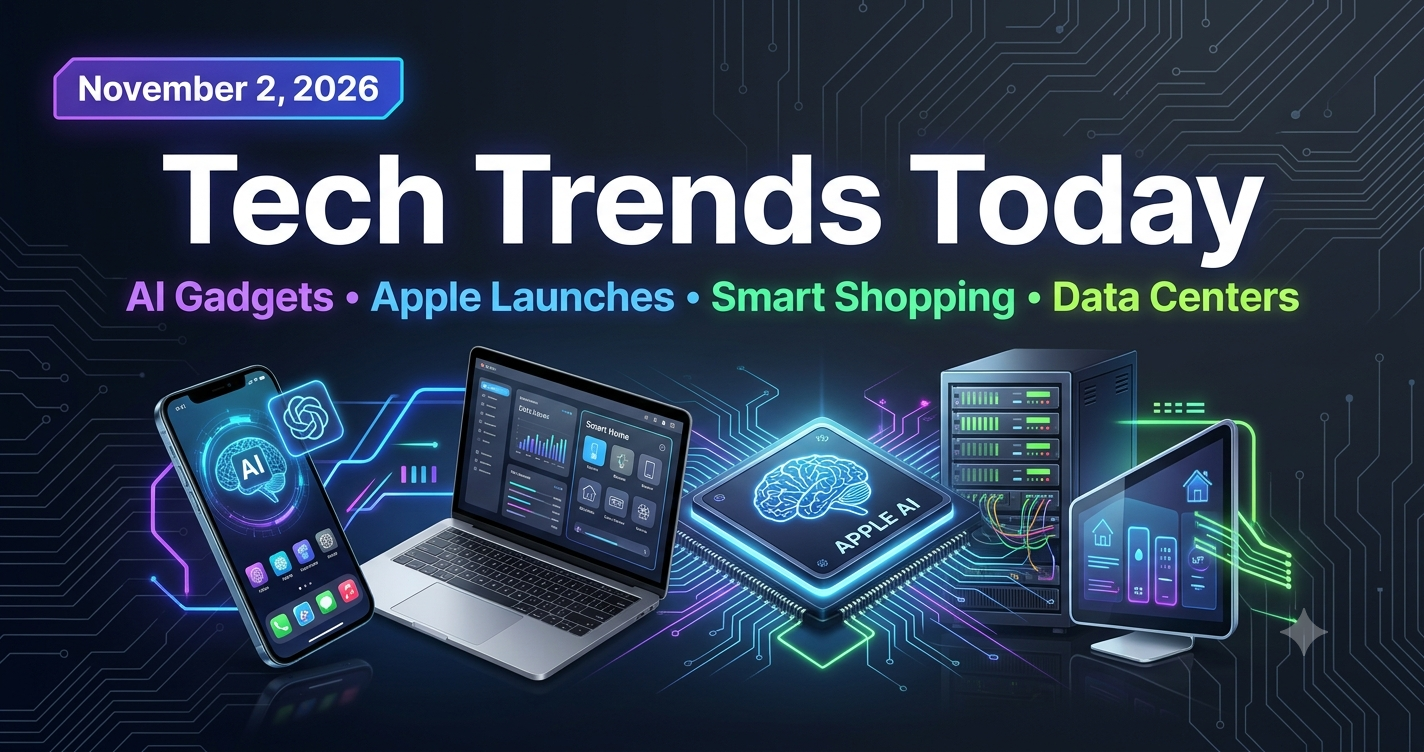
Technology is moving faster than most people can follow. One day, AI is a chatbot; the next, it is inside your TV remote, your smart-home display, your shopping app, and the massive data centers powering everything behind the scenes.macrumors+2
On November 2, 2026, several major stories show where the industry is heading. Apple is preparing a major product rollout, Google is testing AI-powered fashion discovery in India, Marvell has announced one of the biggest chip-industry acquisitions ever, and investors are beginning to question whether the AI infrastructure boom can sustain its enormous spending.reuters+3
For consumers, this means smarter devices and more AI features. For businesses, it means a fierce competition for chips, electricity, data centers, and attention. Let’s break down the biggest stories and what they actually mean.
Apple’s November Launch Wave: More Than Just New Macs
Apple is not slowing down before the end of 2026. The company is preparing several important launches, including new iPads, Macs, a smart-home display, and an updated Apple TV 4K.macrumors+1
The most interesting part is not just the hardware. It is how deeply Apple Intelligence is being built into everyday devices.
New Apple Products Arriving This Month
Apple’s reported November lineup includes:
-
OLED iPad mini with A20 Pro chip, starting at $699
-
M6 iMac, starting at $1,499
-
14-inch MacBook Pro with M6 chip, starting at $1,999
-
14-inch and 16-inch MacBook Pro models with OLED touchscreens, starting at $2,899 and $3,399
-
Apple HomeView smart-home display, priced at $299
-
Fourth-generation Apple TV 4K, also priced at $299macrumors+1
The OLED touchscreen MacBook Pro models are especially notable because they would be Apple’s first touchscreen Macs. That is a major shift for a company that has long resisted touchscreens on laptops.macrumors
Why Touchscreen Macs Matter
For years, Apple argued that touchscreens belonged on iPhones and iPads, while Macs should use a keyboard and trackpad. That position made sense when macOS was designed primarily for desktop productivity.
But AI has changed the way people use computers. Users now want to interact with content more naturally: tapping, drawing, annotating, swiping through media, and using visual interfaces. A touchscreen MacBook could make creative work, presentations, video editing, and AI-assisted design more intuitive.macrumors
This also brings Apple closer to the hybrid device category that Windows PC makers have explored for years. If Apple executes well, it could redefine what people expect from a premium laptop.
Apple HomeView: The Smart Home Gets a Real Brain
Apple’s HomeView may be one of the most important consumer gadgets of the month. Priced at $299, it will be available in tabletop and wall-mounted versions and is designed to act as a central smart-home hub.macrumors+1
It can answer questions using Siri AI, display photos, make FaceTime calls, play music, show recipes, and manage calendar events. It can also recognize up to six users through face recognition and give each person a personalized Home Screen.macrumors
What Makes HomeView Different?
Smart displays are not new. Amazon and Google have offered similar devices for years. But Apple’s advantage is ecosystem integration.
HomeView is expected to connect smoothly with iPhones, iPads, Macs, HomePods, Apple TV, and Apple’s privacy-focused smart-home approach. For households already using Apple devices, it could become the control center for lights, cameras, locks, speakers, and entertainment.macrumors+1
The bigger question is whether people want another screen in their home. Apple is betting that they do—especially if the screen is useful, private, and deeply connected to the rest of their digital life.
Apple TV 4K Gets Smarter, Not Just Faster
The fourth-generation Apple TV 4K is also arriving on November 13. It will include Siri AI, an A19 chip, an updated Siri Remote with Find My support, and four-speaker surround sound when paired with HomePod mini 2 or second-generation HomePod speakers.macrumors
This update shows Apple’s larger strategy: turn the living room into an AI-powered entertainment and smart-home space.
Instead of simply streaming movies, the Apple TV may become a hub where users ask questions, control smart devices, search content naturally, and connect audio systems across the house.macrumors
For Indian users and global buyers alike, the important question will be pricing, regional content support, and whether Siri AI performs better than previous voice assistants. Hardware alone will not win the living room; useful AI will.
Google Pay’s AI Shopping Pilot: A Big Deal for India
While Apple focuses on the home, Google is focusing on how people shop. Google Pay has started piloting a new fashion and lifestyle shopping experience in India called Discover Shop.gadgets360+1
The feature is currently available to a limited group of users. It lets people discover clothing, explore outfit ideas, and find products through visual search inside the Google Pay app. It also includes a virtual try-on feature that shows how selected clothing items may look and drape on the user before purchase.gadgets360+1
Why This Could Change Online Shopping in India
India is one of the world’s most important mobile-first markets. Millions of users already rely on Google Pay for payments, rewards, and everyday transactions. Adding fashion discovery and AI-powered virtual try-on could turn the app into more than a payment tool.
The feature is powered by Google’s Shopping Graph, which includes more than 60 billion products. That gives Google a huge advantage in product discovery, visual matching, and personalized recommendations.gadgets360
For small fashion brands, this could create a new discovery channel. For shoppers, it could reduce one of the biggest problems in online clothing purchases: uncertainty about fit, style, and appearance.
The Real Challenge: Trust and Accuracy
Virtual try-on sounds impressive, but it must be accurate. If the AI shows clothing that looks different in real life, users may lose trust quickly.
The winning platforms will be those that combine AI visuals with honest product details, reliable returns, clear sizing information, and strong seller quality. Google’s pilot is still limited, but it signals that shopping apps are becoming visual, conversational, and AI-first.gadgets360+1
Marvell’s $115 Billion Lumentum Deal: The Hidden Battle Behind AI
One of the biggest technology stories today has nothing to do with a phone, laptop, or smart speaker. Marvell Technology is buying optical components maker Lumentum in a $115 billion all-stock deal, including debt.reuters
The deal is aimed at strengthening Marvell’s position in AI data centers, where it competes with Broadcom and other major chip and networking companies.reuters
Why Optical Components Matter
AI models need enormous computing power. But raw chips are only part of the story.
Data centers also need high-speed connections between thousands of GPUs, servers, storage systems, and networking equipment. Optical components help move data using light, which is essential for high-bandwidth, low-latency AI infrastructure.reuters
In simple words: AI needs not only powerful brains but also super-fast nerves. Lumentum gives Marvell more control over those nerves.
What This Means for the Tech Industry
This acquisition shows that the AI race is no longer only about designing better GPUs. It is about controlling the full stack:
Marvell’s move is a direct response to the enormous spending by hyperscalers such as Google, Amazon, Meta, Microsoft, and Oracle. The companies that supply the plumbing of AI may become just as important as the companies building the models.businessmirror.com+1
AI Spending Is Huge—But Investors Are Getting Nervous
The AI boom is creating incredible demand, but it is also creating financial pressure.
Technology stocks have been volatile because investors are questioning whether massive AI investments will generate profits quickly enough. Alphabet’s disappointing core search sales and negative free cash flow contributed to a major market reaction, while Amazon also reported weaker-than-expected free cash flow after heavy capital spending.businessmirror.com+1
The AI Bubble Question
Some analysts worry that AI infrastructure spending may be overheating. Others believe the demand is real but will take longer to translate into profits.
Both views can be true at the same time.
AI demand is clearly real. Companies are buying chips, building data centers, developing robotics, and investing in new software. But the cost of building this infrastructure is enormous, and returns may take years.businessmirror.com+1
For consumers, this may mean better products and more capable AI features. For investors, it means watching not only product launches but also cash flow, power costs, chip supply, and enterprise adoption.
AI Is Moving Into Robotics and Real Work
Another major trend is the shift from AI demonstrations to AI that can actually perform useful work.
Reuters reported that China’s robotics companies are focusing more on software that helps machines perform unfamiliar jobs, rather than only showing off humanoid robots. Embodied-AI companies attracted approximately $13 billion across 322 deals in the first half of 2026, five times the amount from the previous year.teccurrent
Why Robotics Is the Next Gadget Category
Robotics may become the next major consumer and industrial technology wave. But the breakthrough will not come only from robot bodies. It will come from AI systems that can understand environments, follow instructions, adapt to mistakes, and complete practical tasks.
Think of robots that can:
The companies that win will not necessarily be those with the most human-like robots. They will be the ones with the best software, safety systems, sensors, and real-world training data.teccurrent
Google’s Detachable Googlebook Could Challenge Tablets
Google is also planning to expand its Googlebook lineup with detachable devices that can work as both a tablet and a laptop. The announcement came during Android Dev Summit 2026.digitaltrends
This could be important for users who want one device for entertainment, note-taking, writing, coding, and productivity. Instead of carrying a tablet and laptop separately, a detachable Googlebook could offer both experiences in one product.digitaltrends
Can Google Compete With iPad and Windows Laptops?
Google’s challenge will be software. Tablets succeed when apps are optimized for touch, productivity, stylus input, and multitasking. Laptops succeed when they offer desktop-class performance and professional software.
A detachable Googlebook must deliver both. If Google combines strong Android apps, ChromeOS-style productivity, AI features, and good keyboard accessories, it could create a serious alternative for students, creators, and mobile professionals.digitaltrends
What These Trends Mean for Buyers in India
For Indian consumers, several trends stand out:
-
AI shopping is arriving: Google Pay’s Discover Shop pilot could make fashion discovery more visual and personalized.gadgets360+1
-
Smart homes are becoming practical: Apple HomeView may appeal to users already invested in the Apple ecosystem.macrumors
-
Laptops are changing: Touchscreen Macs and detachable Googlebooks could blur the line between tablets and computers.macrumors+1
-
AI features will decide value: Buyers should look beyond camera megapixels and processor names. Useful AI features, privacy controls, battery life, and long-term software support will matter more.
-
Prices may rise: AI demand has increased pressure on memory, chips, and components, which can affect gadget prices over time.techmeme
How to Choose AI Gadgets Wisely
Before buying the next “AI-powered” device, ask these questions:
-
Does the AI feature solve a real problem?
A virtual try-on, smart-home automation, or better voice search is useful only if it saves time or improves results.macrumors+1
-
Does it work offline or require constant internet?
Many AI features depend on cloud processing, which affects privacy, speed, and data usage.
-
Is your data protected?
Check what data the device collects, how it is stored, and whether you can disable AI training or personalization.
-
Will the device receive updates?
AI gadgets need regular updates for security, new features, and compatibility.
-
Is the ecosystem worth it?
A smart-home display is more valuable if it works smoothly with the devices you already own.macrumors+1
The Bigger Picture: AI Is Becoming Infrastructure
The biggest lesson from today’s news is that AI is becoming infrastructure—like electricity, internet, and mobile networks.
Apple is putting AI into homes and computers. Google is putting AI into shopping. Marvell is buying the optical technology needed to move AI data. Oracle is raising billions to fund AI infrastructure. Countries such as South Korea are increasing AI budgets to compete globally.reuters+4
This means the next few years will not simply be about “AI apps.” They will be about AI-powered devices, AI-powered networks, AI-powered factories, and AI-powered cities.
Finally
November 2, 2026, may look like just another busy tech-news day, but it reveals a clear direction for the industry. Gadgets are becoming intelligent assistants. Shopping is becoming visual and predictive. Homes are becoming connected command centers. And behind all of it, companies are spending billions to build the chips, networks, and data centers that make AI possible.